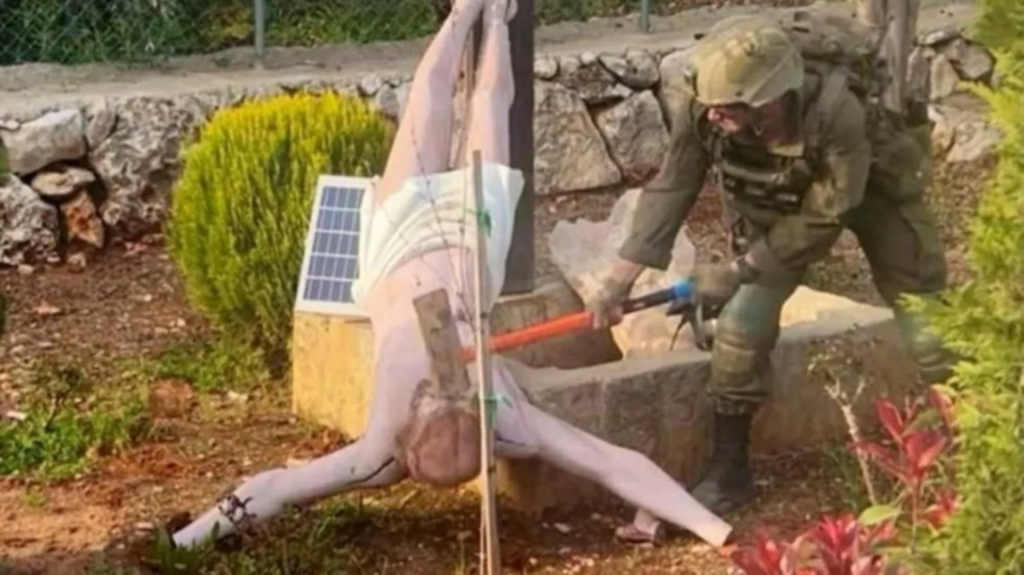
By now you’ve likely seen the photograph shared everywhere. An Israeli soldier in southern Lebanon, sledgehammer in hand, smashing a statue of Jesus at a small roadside shrine in the village of Debel. The image went viral. Church leaders and politicians issued statements, and social media erupted. And Israeli Prime Minister Benjamin Netanyahu condemned it “in the strongest terms.”
And while it is understandable that the act was uncalled for, the response was worse. 30 days in detention? Public outrage? People making a hue and cry about a statue. Really? A statue?
Doesn’t this bother you? Yes, desecrating a holy symbol is wrong, and I understand the hurt. What bothered me was the proportion of that outrage. A statue made of stone dominated the global Christian conversation for days. Meanwhile, actual human beings — actual brothers and sisters in Christ — are being slaughtered by the thousands, and most of those same voices are barely whispering.
Let me show you what I mean.
Jesus wasn’t in that statue
Let’s start with the obvious. Jesus is not in that statue. He never was.
The prohibition against idol worship runs throughout the entire Old Testament, and Jesus himself — the same Jesus who taught in the Temple, who quoted Torah, who kept the feasts — inherited that tradition without apology. “You shall not make for yourself a graven image,” Exodus 20:4. The early church had no statues, no paintings, no images. They only had the Holy Spirit.
I’m not here to say don’t keep statues. I know many sincere Christians use images devotionally, as visual aids in prayer, not objects of worship. I’m not condemning anyone’s spiritual practice.
But let’s be honest: Jesus is not harmed when His image is smashed. He’s fine. He’s seated at the right hand of the Father. He has been through worse than a soldier with a sledgehammer. He’s been to hell and back, literally; and He’d have something to say about how the religious folk are getting so worked up about a statue.
Was it just because it happened at the hands of a Jew? Where were these same people when the statues in other countries were vandalized? When Christian lives in other countries are being taken?
Did they say anything when the statue of Christ the Redeemer at the Holy Redeemer Catholic Church in Ambala, Haryana was vandalized and broken on Christmas Day? Or when miscreants entered St Mary’s Church in Periyapatna, Karnataka and damaged the infant Jesus statue two days after Christmas? Or when churches were being burnt in Khartoum and lives destroyed?
“Turn the other cheek” is not a cliché
In Matthew 5:39, Jesus says: “But I tell you, do not resist an evil person. If anyone slaps you on the right cheek, turn to them the other cheek also.” That verse is about personal honour — the slap on the right cheek in Jewish culture was a backhand, delivered to shame the person. Jesus says: don’t make your dignity the issue.
A stone statue is, if anything, a lesser provocation.
I’m not saying we stay silent about desecration. I’m saying our energy is finite, and we are choosing what to amplify. Millions of Christians spent emotional energy on a statue while staying quiet about what’s happening to the living body of Christ.
The actual massacre that nobody is discussing
Here are real numbers, from this year.
According to Open Doors’ World Watch List 2026, 4,849 Christians were killed for their faith in the most recent reporting period. Of those, roughly three out of every four people were killed in Nigeria. That is not a typo. Nigeria alone accounts for more Christian martyrs than the rest of the world combined.
And if you think those numbers are big, hear this.
In the first 220 days of 2025 alone, Intersociety reported that at least 7,087 Christians massacred across Nigeria – that’s an average of 30 people every single day. These are not abstract statistics. They are farmers, pastors, grandmothers, children, hacked to death or shot in their villages by Boko Haram, Fulani militants, and similar groups.
In the Yelewata massacre of June 2025, 280 Christians were killed in two days. In the Sankera massacre of April 2025, over 72 people were hacked to death.
In Syria, the terrorist attack at Saint Elias Church in June 2025 saw 25 people lose their lives while 60 others were injured. Parts of Mali are considered unlivable for Christians because of the continued violence.
Did you see any of that trend on your timeline?
Sudan: a genocide few are naming
In Sudan, the civil war that began in 2023 has displaced more than 10 million people. Churches have been bombed. Clergy have been shot or stabbed during raids. Christians have been excluded from humanitarian aid distributions and told, “you don’t belong here.” One hundred and sixty-five churches have had to close since the war began.
The Rapid Support Forces — who grew out of the Janjaweed militias responsible for the Darfur genocide — have been carrying out systematic mass killings. The United States declared in early 2025 that the RSF was committing ongoing genocide. Sudan now holds the fourth spot on the Open Doors World Watch List, with the second highest violence score.
India: a different kind of persecution, but no less real
India’s violence is less about mass killing and more about relentless, daily attrition — and it has been setting newer records every year in the last decade.
In 2025, local monitoring groups of Christian Solidarity International “recorded nearly 900 cases of physical assaults, disruptions to church services, and threats against worshippers” in many Indian states, making it the worst year for Indian Christians since independence in 1947. Pastors have been dragged out of services and forced to eat cow dung. A BJP politician walked into a church on Christmas Day and assaulted a visually impaired woman. Anti-conversion laws — which effectively make it a crime to share your faith — have been weaponised against hundreds.
The Evangelical Fellowship of India’s Religious Liberty Commission (EFIRLC) said that attacks against Christians in India have more than quadrupled since 2014 — from 147 verified incidents that year to 640 in 2024. And those are just the verified ones.
In February 2025, a Hindutva leader explicitly called for a genocide against Christians in three villages in Chhattisgarh.
As Christians in India, these instances don’t shock us the way it shocks the global church. Because we’ve watched the global church be generally silent about it. But someone destroys a lifeless statue. What a hue and cry that created!
What should we actually do?
First, pray. Not as a consolation response, but as warfare. Intercessory warfare does really make a difference. Our brothers and sisters in Nigeria and Sudan and northern India are not statistics — they are the church, and they need us standing in the gap.
Second, give. Open Doors and International Christian Concern both do direct, documented work with persecuted believers. They are trustworthy organisations that put money where it matters. There are many more such organizations to support – Global Christian Relief, Barnabas Aid, The Voice of the Martyrs, and others.
Third, use your voice. Talk about Nigeria. Talk about Sudan. When your feed fills with outrage about a statue, ask the question out loud: “What about the people?”
Back to the soldier in Lebanon
Prime Minister Netanyahu condemned the act. The Israeli military confirmed the photo was authentic and said the soldier’s actions went against Jewish values of tolerance, and he was punished for it. That is the appropriate response from a government, and it happened.
But the statue has already being replaced. The families in Benue State, in Khartoum, in Chhattisgarh — their losses are not so easily repaired.
Jesus said the greatest commandment was to love God, and the second was to love your neighbour. Nowhere did he say to love his image in stone. He said to love the person.
And right now, His people — made in the image of the living God, not carved from marble or stone or wood — are dying in numbers that should shake the global church to its core.
Let’s talk about that.
A few sources worth reading:
- Open Doors World Watch List 2026
- Christianity Today: The 50 Countries Where It’s Most Dangerous to Be Christian in 2026
- International Christian Concern: Sudan
- Christian Solidarity International: India 2025
Other Faith-based Posts:
- Why Tithe as a Christian in the New Covenant?
- Mardi Gras is not for Christians
- Christian Marriage Quotes
- The History of Israel
- Must-read books about the Holy Land

Heya, I’m Abby! I’m a Gourmand Award-winning cookbook author and East Indian from Bombay, India. This blog is all about faith, food, and culture – from East Indian recipes to home, DIY, and spending time in the Word. Find out more about me here!