Every church has one. That one person who side-eyes you during prayer because your hands are folded instead of raised, or raised instead of clasped, or God forbid, stuffed in your pockets during intercession and prayer.
Welcome to one of Christianity’s most passionately unresolved debates, ranking just below “should the worship band play that song again” and “is the communion grape juice or wine.”
A Completely Scientific Survey of Prayer Hand Positions Currently in Use
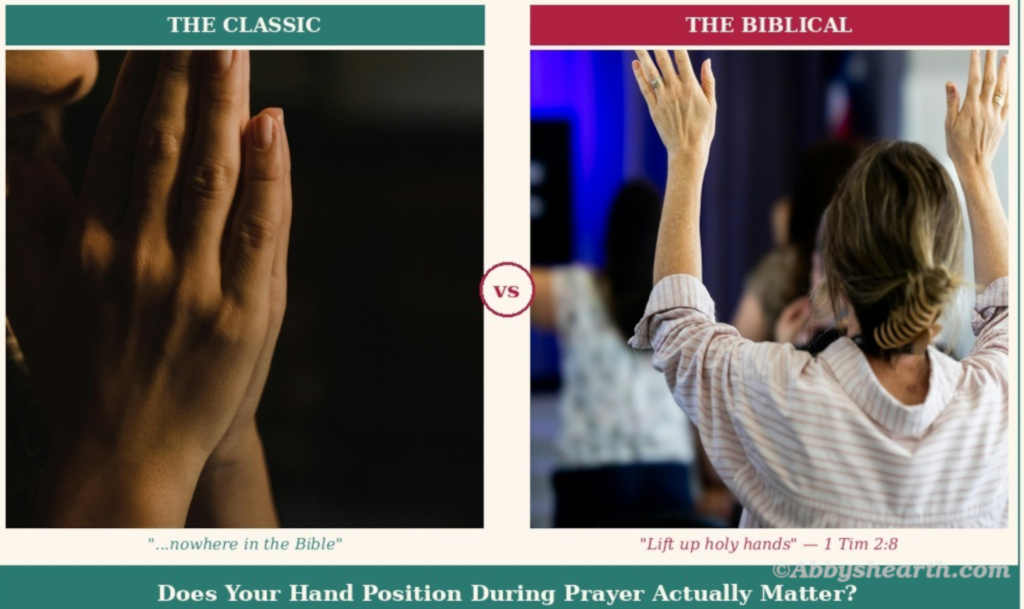
The Classic Clasp — Fingers interlocked, head bowed, the posture that every Sunday school drawing ever made. Deeply reverent and traditional, but absolutely nowhere in the Bible.
The Steeple — Fingertips pressed together, forming a small architectural feature above the knuckles. This one makes you look like you’re either praying or about to deliver a TED talk. Possibly both.
The Raised Hands — Arms up, palms open, the full surrender position of men we emulate and women of faith. This is the one that makes newcomers nervous and the worship team very happy. Also, notably, the one that actually appears all over the Bible.
The One Hand Raised, One Hand in Pocket — A casual hybrid favoured by people who are worshipping but also slightly cold.
The Folded Arms — Technically this is just standing. But some people do pray like this and Abba hears them too.
The Hands-Behind-Back — The prayer posture of choice for people who are walking and praying simultaneously, usually around a church building or a garden, feeling very Old Testament about it.
The Phone-in-Hand — This one is new. You’re reading your Bible app with one hand and theoretically praying with the other. Points for multitasking. Questionable points for focus.
So What Does the Bible Actually Say?
The Bible mentions prayer often, from the conversation God had with Adam and Eve in the Garden of Eden (Genesis 3:8–13) to the twenty-four elders falling prostrate on the floor to worship the Lamb (Rev 5:14).
And while there are so many mentions of different prayer positions, the one that comes up most consistently is not the clasped-hands-bowed-head picture we grew up with. That image is largely a medieval and Renaissance art tradition, not a biblical representation of faithful prayer.
What Scripture actually describes, repeatedly, is raised hands.
I will praise you as long as I live, and in your name I will lift up my hands.
Psalm 63:4, NIV
Therefore, I want men to pray in every place, lifting up pure hands, without anger or dissension.
1 Timothy 2:8, New International Version
Lift up your hands in the sanctuary, And bless the LORD.
Psalm 134:2, New King James Version
Ezra said, “Praise the LORD, the great God!” All the people raised their arms in the air and answered, “Amen! Amen!”
Nehemiah 8:6, Good News Translation Catholic Bible
Let us lift up our hearts and our hands to God in heaven.
Lamentations 3:41, International Standard Version
There’s also kneeling (Daniel 6:10, Ephesians 3:14), prostration (Matthew 26:39 — Jesus himself, face to the ground in Gethsemane), and standing with eyes toward heaven (John 17:1).
What there isn’t anywhere in all of this is a diagram of interlocked fingers or the fingertips pressed together.
But Does It Actually Matter?
No. And also, a little bit yes.
The prayer position doesn’t save you, sanctify you, or make your prayer more powerful. God hears the heart, not the hand coordinates. You can pray face-down on the floor, standing on a bus, or as many of us have quite often, completely horizontal at 2 am staring at the ceiling, and He hears every word. Another way I’ve found to make prayer tangible is making faith-based glue art, and quite often He gives me the ideas to create.
What posture can do is help your body agree with what your heart is doing. There’s something about raised hands that’s physically hard to do while simultaneously holding onto anxiety, pride, or distraction. It’s a posture of surrender, and surrender is rather the point. Which is probably why it keeps showing up in Scripture.
The next time someone side-eyes your hand position during worship, you have two options.
Option A: Smile graciously and say nothing.
Option B: Hand them a copy of 1 Timothy 2:8 and raise both hands very slowly while maintaining eye contact.
Abba is not keeping a hand-position register. But if He were, the biblical evidence suggests the raised-hands crowd would be doing rather well.
If you want to go deeper into what the Bible says about prayer or other faith-based topics, head over to the School of Prayer & Intercession at School of the Spirit — it’s worth your time.
Other Posts You Might Like
- Daniel Fast
- Rejoice – it’s a choice!
- What does the Bible say about Israel?
- Bible beliefs that aren’t really true
- Hiding our light is harder than it looks
- Why it’s important to dress like a child of the King?
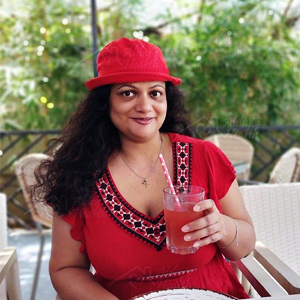
Heya, I’m Abby! I’m a Gourmand Award-winning cookbook author and East Indian from Bombay, India. This blog is all about faith, food, and culture – from East Indian recipes to home, DIY, and spending time in the Word. Find out more about me here!