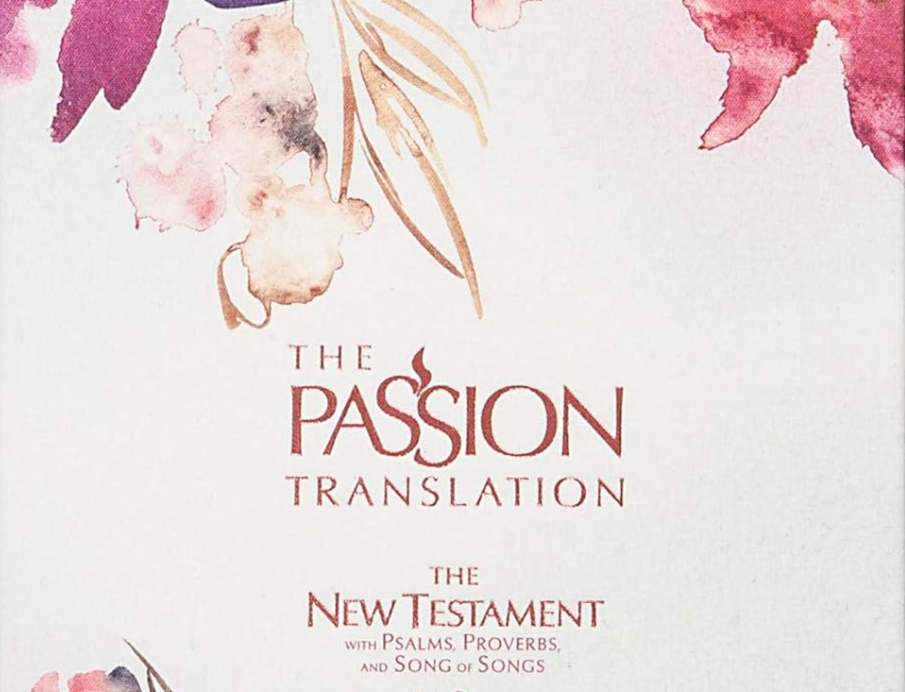
I love reading the Passion Translation, it’s on the list of my favourite Christian books. But it deserves more of a mention than just a paragraph in a post because the questions people ask about it are worth answering, and the reasons to read it are worth spelling out.
So here’s a proper look at what the Passion Translation is, who Brian Simmons is, what the controversy is actually about, and why, after all of it, I still think you should have a copy and read it regularly.
What Is the Passion Translation?
The Passion Translation (TPT) is a modern rendering of the Bible by Dr. Brian Simmons, a linguist, Bible scholar, and former missionary who planted multiple churches in Central America. The project began with the New Testament and Psalms and has since expanded to cover the full Bible.
The name comes from Brian Simmons’ central aim: to convey the passion of God’s heart — His burning love for His people — in language that is alive, emotionally resonant, and accessible to contemporary readers.
While the King James Version gives you grandeur and the NIV gives you clarity, the Passion Translation gives you warmth. It reads as though the writer spent decades in the presence of God before sitting down and writing out what he understood to be the heart behind the words.
Who Is Brian Simmons?
Dr. Brian Simmons spent years as a missionary translator in Panama and Belize, working with the Paya-Kuna people to translate portions of Scripture into their language. That painstaking, prayerful discipline of finding the right words in one language to carry the meaning of another forms the foundation of everything he did with the Passion Translation.
After pioneering multiple church plants in Central America with his wife Candice, he returned to the US and birthed the Gateway Christian Fellowship in West Haven, Connecticut as well as Stairway Ministries which allows them to travel globally teaching the Bible, as well as Passion and Fire Ministries that provides online teachings, tours courses and more that help us connect to the passionate heart of God.
If learning God’s heart is something you yearn for, then you’ll feel at home in the Passion Translation immediately. If it’s not your primary focus, read on because the value of this work goes beyond stream preference.
Is the Passion Translation a Real Bible “Translation”?
Here is where many people get stuck, and it’s worth addressing honestly. The Passion Translation can more accurately be described as a paraphrase than a word-for-word translation. Dr. Simmons himself has acknowledged this. He worked primarily from the Greek, Hebrew, and Aramaic texts, but his goal was not the mechanical equivalence that you get with word-for-word accuracy or even dynamic equivalence that is brought forth in thought-for-thought clarity. His goal was to capture the feeling of the text and showcase God’s heart for us in a way that other translations don’t always prioritise.
This is not unusual. The Message, by Eugene Peterson, does something similar. The Living Bible, which millions of Christians have grown up reading and loving, is a paraphrase. These works exist because different readers come to Scripture differently, and different renderings open different doors.
The criticism of the Passion Translation from some scholars is that Dr. Simmons occasionally adds interpretive weight to the text — a word here, a phrase there that isn’t in the original manuscripts. That is a fair scholarly observation, and if you are doing serious Bible study, you should be aware of it. Cross-reference with a more literal translation like the ESV, NASB, or King James version when you’re digging into doctrine or theology.
But dismissing the Passion Translation because it is a paraphrase misses the point of what it is for. It was never meant to replace your study Bible. The Passion Translation is simply there to help you feel what you already know.
What the Passion Translation Does Beautifully
It Opens Up the Psalms
Read Psalm 23 in the Passion Translation and then read it in the King James. Both are beautiful. But TPT puts words around the intimacy of that psalm that can stop you mid-sentence. There is a tenderness in Simmons’ rendering that makes familiar verses feel new — not because the meaning has changed, but because you never saw it that way before.
It Makes Paul Readable
Paul’s letters in the New Testament are dense. They were written by a highly educated rabbi, in Greek, to specific communities dealing with specific problems, and the theological arguments are layered and complex. Many Christians read Romans and Ephesians dutifully but without the sense that these are love letters. The Passion Translation restores that sense. You feel the urgency, the affection, the pastoral heart behind the arguments.
It Unlocks the Song of Songs
The Song of Songs is one of the most misread and under-read books in the Bible. Many Christians treat it as an awkward inclusion — a love poem that somehow ended up between Ecclesiastes and Isaiah. Dr. Brian Simmons treats it as exactly what the early church and the Jewish tradition always understood it to be: an allegory of God’s passionate love for His people, and His people’s longing for Him. His rendering of the Song of Songs is extraordinary. If you read nothing else in the Passion Translation, read that.
It Reflects a Heart That Has Spent Time in the Presence of God
This is the thing that is hardest to quantify and most important to say. You can detect, in the Passion Translation, a translator who loves the God he is translating. And a lot of that intense love rubs off on you.
How to Use The Passion Translation Correctly
The Passion Translation works best when you use it alongside other versions rather than instead of them. Here’s a simple pattern that many people find helpful.
Read a passage in the Passion Translation first, to feel the heart of it. Then read the same passage in a more literal translation — the ESV, the NASB, or the King James — to anchor yourself in the exact words. Let the two readings speak to each other. You could also do it the other way around. Read the KJV or ESV to know the text, and then read the Passion Translation to go into the depths of emotions it evokes in you.
For devotional reading, prayer, and encountering God’s love — the Passion Translation on its own is exactly right. For preaching, teaching, or serious doctrinal study, pair it with something more literal.
Why You Should Read It More Often
There is a kind of Christianity that is theologically correct and emotionally cold. It knows all the right doctrines, can defend them in argument, and quotes the right Bible versions — and yet has lost the sense that God is a Father who loves His children with a love that surpasses understanding.
The Passion Translation is a corrective to that. It insists, on every page, that the God of Scripture is not a distant judge issuing decrees but a pursuing, passionate, tender Father who gave everything — His own Son — because He wanted us back.
Abba speaks throughout the whole Bible. The Passion Translation is one of the clearest windows I’ve found into the love behind what He says. Get a copy and read it slowly. Let it do what it was designed to do.
Further Reading on Abby’s Hearth
- My Favourite Christian Books — the full list, including other Bible versions worth having
- 28 Bible-Based Declarations to Encourage You — scripture to speak over your life
- 13 Types of Fasting in the Bible Every Christian Should Know — building a deeper prayer and fasting practice
- Beyond the Veil — Intimacy with Jesus — on drawing closer to God
Have you read the Passion Translation? I’d love to hear what passages have meant the most to you — leave a comment below.

Heya, I’m Abby! I’m a Gourmand Award-winning cookbook author and East Indian from Bombay, India. This blog is all about faith, food, and culture – from East Indian recipes to home, DIY, and spending time in the Word. Find out more about me here!