Congratulations to the food world for catching up.
Somewhere in a very expensive restaurant, a chef is explaining to a table of very impressed diners that he sources his organ meats “ethically” and uses “the whole animal” because he is “deeply committed to reducing food waste.”
His grandmother, had she been East Indian, would have looked at him and said, “Beta, we call that Tuesday.”
The nose-to-tail eating movement — in case you have missed it — is the revolutionary idea that animals have more than four cuts of meat and that perhaps the rest of it is also edible. Food writers are calling it brave. Chefs are calling it philosophy. East Indian grandmothers are calling it dinner.
We have been eating the whole animal since there was a whole animal to eat. Not because it was trendy. Not because a Michelin-starred restaurant put it on a tasting menu with a smear of something underneath. Because it is delicious, because nothing goes to waste, and because Granny made it that way and Granny was always right.
Allow me to introduce you to the East Indian offal canon.
The Brain
Let us begin with the thing that makes the most people nervous: the brain.
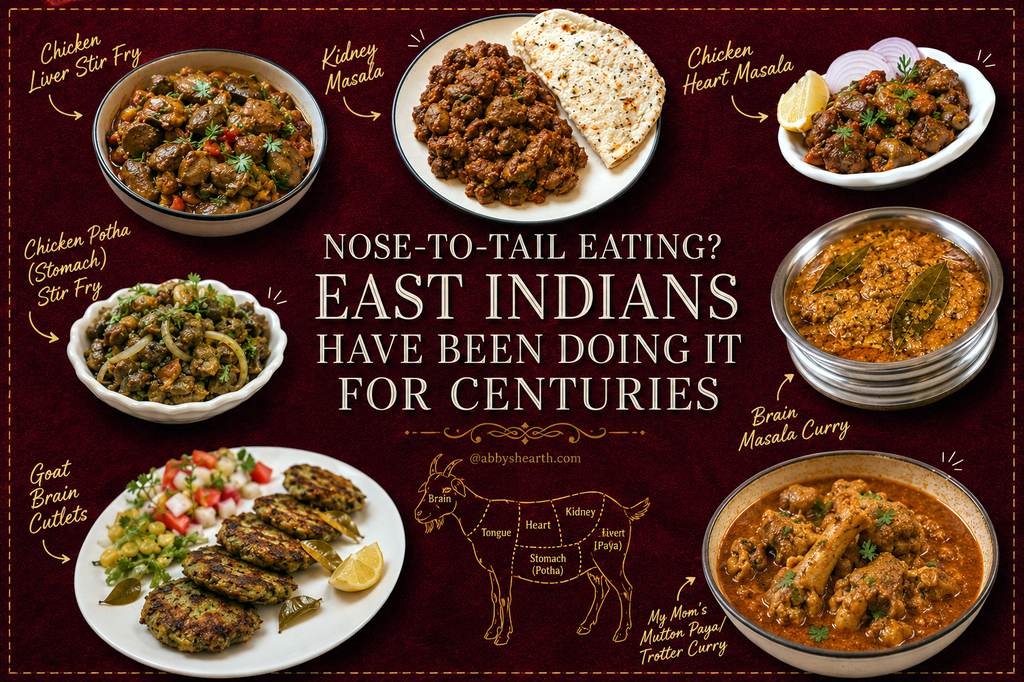
Goat brains, to be precise. In our house it became Goat Brain Masala — cooked down in a spiced gravy until it is soft and yielding, served with pav or rice, gone before you can feel conflicted about it. My mother made it without ceremony. It appeared on the table the way other families’ chicken appeared on the table: as food.
Brain cutlets are the other preparation — the brain is boiled, mixed with spices and egg for binding, and then spooned into a pan and fried. The result is something the nose-to-tail movement would put on a small plate and charge you forty dollars for. We ate them standing in the kitchen before they made it to the table. (This recipe is one of the many dishes in our award winning cookbook – Jevayla Ye – you know the one that was named Best Indigenous People Cookbook in the World in 2025 at the World Gourmand Cookbook Awards.)
The Tripe
Vajri Khudi is the East Indian name for the goat tripe curry, and it is a slow-cooked, deeply spiced thing that rewards patience. Vajri is the stomach lining, and khudi means a curry. The combination is not apologetic about what it is, and it does not need to be. It is one of the best things you will eat.
The food world discovered tripe sometime around 2015 and began calling it “honeycomb” so people would order it. East Indians never had to rename it. We already knew what it was and we wanted it.
The Feet
Yes, we eat the feet.
Mutton Paya Khudi aka goat trotters curry is collagen-rich, gelatinous and sticky in the best possible way, and the sort of thing you eat slowly because the bones require your attention. In other parts of the world, people are now paying a great deal of money for bone broth. Paya has been producing bone broth as a side effect of being delicious for several hundred years without asking for any credit.
The Tongue
The tongue is perhaps the offal that requires the least convincing once you have tried it, because it tastes like the best, most tender braised beef you have ever eaten, if the best, most tender braised beef you have ever eaten also had a slightly gelatinous, meltingly rich quality that nothing else quite replicates.
We have several approaches to tongue in this household.
Beef Tongue Roast is the celebratory version wherein the tongue is boiled, the outer membrane is removed (this sounds dramatic and is the part where people who are new to tongue feel things), and then it is roasted with onions and raisins to make something so delicious you’ll want to eat it everyday.
Tongue Moilee is our curry version — cooked in a pressure cooker or on the stove-top if you prefer the slow-cooked version. Made with ghee, onions, and green masala and spices, it’s gentle, aromatic, and deeply satisfying.
Corned Tongue is our preserved version — salt-cured, boiled, sliced thin and served on a bed of boiled cauliflower and green peas. It is what happens when you apply charcuterie logic to the tongue and arrive somewhere excellent.
Goat or Sheep Tongue Masala is the smaller-format version — the same principle, applied to the more petite tongues of smaller animals, cooked in a spiced masala gravy.
If you are counting, that is four tongue recipes. We are deeply committed to our offaly essence.
The Heart
The heart is a muscle, which means it is lean and flavourful and takes on spice extremely well.
Chicken Heart Masala is mom’s recipe where the hearts are cooked down in a rich masala until perfectly spicy on the outside and tender inside. It is our mom’s perfect East Indian concentrated flavour in small packages.
Chicken Heart Stir Fry is the faster, spicier version — high heat and chillies done quickly. The sort of thing you make when you want dinner to be ready before you have finished thinking about it.
The Gizzard
The Chicken Gizzard Chilly Fry does not ask for your approval. The gizzard is a firm, muscular organ that requires longer cooking than most things, and rewards your patience with a texture and flavour that nothing else quite delivers. It is chewy in a satisfying way and deeply savoury. Gizzard or tetha as it’s called in East Indian Marathi is the sort of thing that people who grew up eating it crave, and the sort of thing that people who try it for the first time are surprised to find themselves finishing.
The Liver
We use the liver mainly as stuffing — chicken liver and giblets, cooked down with aromatics and used to fill roast chicken or served alongside. It is the kind of thing that turns a roast chicken or a roast duck or a stuffed little pigling into an occasion.
The food world has been putting chicken liver mousse on toast points for years. We have been putting it inside the chicken, or duck or goose or pigling. We feel our version makes more structural sense.
The Tail
Oxtail Stew, now that’s a moot point. There’s one version that is technically a South African contribution to this household — my sister-in-law Soz brought it with her from Pretoria, and it has stayed because it is magnificent.
But there’s another version of oxtail stew that’s made the same way we make a beef stew or chicken stew, that makes you go back in the kitchen for the next piece, and then the next one. Here’s mom’s recipe!
Cooked low and slow, the collagen from the tail bones dissolves into the stewing liquid and you end up with something rich and glossy and deeply comforting. In the olden times, our granny would skim off the fat from the top to store in mason jars. This in turn would be used as a frying medium for many other recipes.
The Fish Roe
If you thought offal was only about mammals, you have not met gaboli.
Gaboli is fish roe or the fish eggs, and in our household it is not a garnish or an accent or something that arrives in a small spoon with crème fraîche like in restaurants where you’d pay $100 for it to. It is a main event. It is fried until crispy on the outside and creamy inside. It becomes a vindaloo. We boil and store it so we have it through the year. There are nine ways to eat it on this blog and we are probably not done yet.
The Kapuras
Kapuras are goat testicles. I have now told you what they are. What I will also tell you is that they are eaten, beloved, and prepared in this household, and that the recipe is on this blog. Some things deserve their own introduction, and that introduction is: try them before you decide anything.
A Note to the Nose-to-Tail Movement
We appreciate the enthusiasm. We are glad the rest of the world is catching up. We would gently suggest that “brave” and “revolutionary” are perhaps not the words, and that “what everyone’s granny was already doing” might be more accurate.
The whole animal has always been the point. Waste is not a food philosophy; it is a failure of imagination. East Indian grandmothers have known this for a very long time.
The recipes are all here. Pull up a chair.
Want to start somewhere? Goat Brain Masala if you are feeling adventurous. Oxtail Stew if you want something to convert a sceptic. Fried Gaboli if you want proof that the best things are often the simplest.
And if you grew up eating any of these — tell me in the comments which one you miss most.

Heya, I’m Abby! I’m a Gourmand Award-winning cookbook author and East Indian from Bombay, India. This blog is all about faith, food, and culture – from East Indian recipes to home, DIY, and spending time in the Word. Find out more about me here!