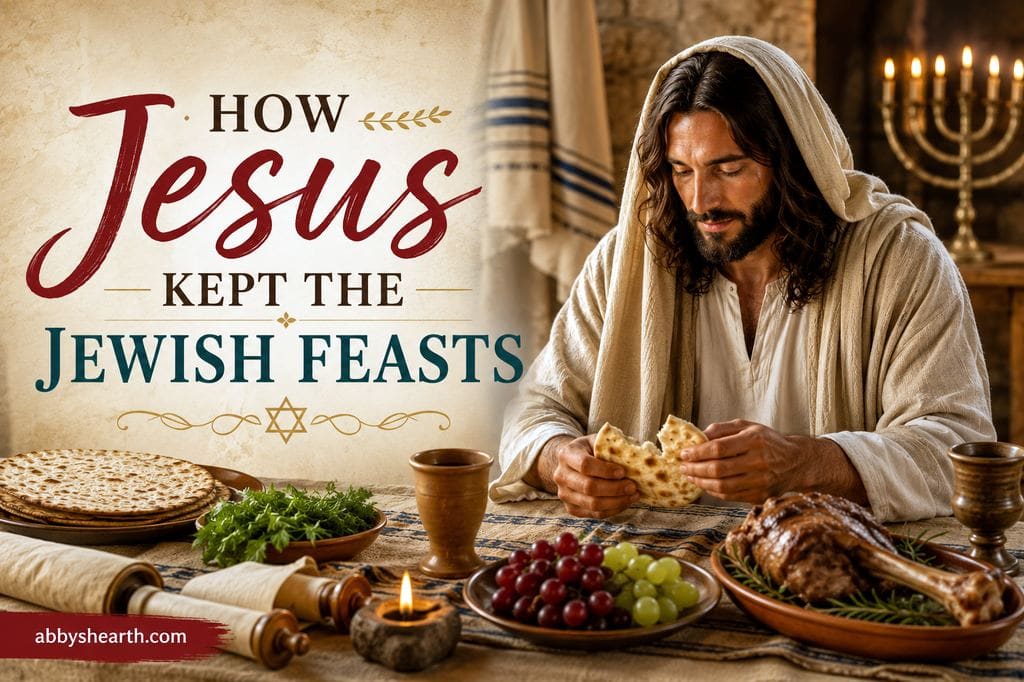
Jesus was Jewish. Correction, Jesus still is Jewish. That begs the question – if, while He was here on earth, Jesus was fully, observantly, and thoroughly Jewish — then why do so many Christians treat the Jewish feasts as if they belong to someone else’s religion?
Our Lord and Saviour didn’t just mention the feasts in passing. He kept them. He travelled to Jerusalem for them. He was crucified on one of them. He rose on another. He sent the Holy Spirit on a third. These aren’t coincidences. They’re the whole story, hidden in plain sight; the calendar of heaven dressed in ancient Hebrew clothes.
Let’s walk through the feasts one by one and see what Jesus did with each of them, and then ask the question that follows naturally: what does that mean for us?
First, Why Do the Jewish Feasts Matter at All?
The seven feasts of Israel, known in Hebrew as the Moedim, meaning appointed times, were first described in Leviticus 23. God didn’t call them Israel’s feasts, or Moses’s feasts. He called them “My appointed feasts” (Leviticus 23:2). His calendar. His rhythm. His chosen moments in time to meet with His people.
That framing matters enormously. These weren’t cultural traditions that Jesus just happened to observe because He was raised in a Jewish home. They were the framework His Father had built long before His arrival, and He stepped into each one deliberately.
The seven feasts are divided into two seasons:
Spring feasts (fulfilled by Jesus at His first coming):
- Passover — Pesach
- Unleavened Bread — Chag HaMatzot
- Firstfruits — Yom HaBikkurim
- Weeks / Pentecost — Shavuot
Autumn feasts (yet to be fulfilled at His second coming):
- Trumpets — Rosh Hashanah
- Day of Atonement — Yom Kippur
- Tabernacles — Sukkot
Every single spring feast was fulfilled by Jesus on the exact day it was celebrated. There is absolutely no chance that this precision is accidental. It’s one of those things that when you consider them, you look up to the Creator of the Universe and marvel at His planning.
Jesus and Passover: The Lamb Was Always Him
Passover commemorates the night God brought Israel out of Egypt. Every household sacrificed a year-old lamb and put its blood on the doorposts of thier houses, and were passed over by the angel of death (Exodus 12). Abba told them to eat the meal in haste, belts on, sandals on their feet, staff in hand, ready to walk out of slavery.
Jesus kept Passover every year of His life. Remember when Mary and Joseph lost Him in the temple in Jerusalem in Luke 2:41 – that was during the Feast of Passover. When He grew up, He continued keeping the feasts like any observant Jew would. The Last Supper — the meal Jesus shared with His disciples before His arrest — was a Passover seder. He took bread and wine in the context of that ancient meal and said: “This is my body… this is my blood of the covenant” (Matthew 26:26–28).
Then, the next afternoon, He died.
John’s account is precise: Jesus died at the ninth hour, the exact time the Passover lamb was slaughtered in the Temple (John 19:14). Paul draws the connection explicitly: “Christ, our Passover lamb, has been sacrificed” (1 Corinthians 5:7).
Jesus didn’t just observe Passover. He became it, for us.
For Christians, communion, the Eucharist, the Lord’s Supper, call it what you will, is a Passover meal. When we take the bread and cup, we are doing what Jesus did every Passover, and what He reinterpreted at His last Passover. Understanding this Passover makes taking communion richer, because the more you understand the Passover lamb, the more you understand His sacrifice of the cross.
Jesus and the Feast of Unleavened Bread: Three Days Without Corruption
The feast of Unleavened Bread begins the day after Passover and lasts seven days. Every home removes leaven or yeast, and eats flat unleavened bread. Leaven in Scripture consistently represents sin, pride, and corruption (1 Corinthians 5:6–8). The feast speaks of a life purged of what corrupts.
Jesus was in the tomb during this feast. His body saw no corruption (Psalm 16:10, Acts 2:27). Peter quotes this directly in his Pentecost sermon — the Psalmist said the Holy One would not see decay, and Jesus was the fulfilment of that word.
The Feast of Unleavened Bread, in its deepest meaning, speaks of the sinless One buried in the earth, intact, uncorrupted, awaiting resurrection. Leaven doesn’t exist in Him. Death couldn’t hold what had no corruption to work with.
Paul’s instruction to the Corinthians lands differently once you see this: “Let us keep the Festival, not with the old bread leavened with malice and wickedness, but with the unleavened bread of sincerity and truth” (1 Corinthians 5:8). He’s using the feast as a live metaphor, assuming his readers understand what the feast means. He expects Christians to know it.
Jesus and Firstfruits: The First to Rise
Firstfruits falls on the third day after Passover — or in practice, the Sunday during Unleavened Bread. It was the day the first grain of the new harvest was brought to the Temple as an offering. The firstfruits were not merely symbolic. They were a pledge, a down payment: here is the first of what is coming. The rest of the harvest will follow.
Jesus rose from the dead on the Feast of Firstfruits.
Paul does not leave this implicit. In 1 Corinthians 15:20 he writes: “But Christ has indeed been raised from the dead, the firstfruits of those who have fallen asleep.” He uses the feast’s exact language. Jesus is not just resurrected; He is also the firstfruits offering. His resurrection is God’s pledge that the rest of the harvest is coming. Every person who is in Christ will follow Him out of the grave.
The spring feasts of Israel, lined up in sequence, read as a direct prophecy of Holy Week: death on Passover, burial through Unleavened Bread, resurrection on Firstfruits. This is not Christian theology retrofitted onto Jewish tradition. This is the Jewish calendar reading as a blueprint that Jesus fulfilled to the day.
Jesus and Pentecost: The Spirit Arrives on Schedule
Shavuot or Pentecost as we know it, falls fifty days after Firstfruits. In the Old Testament it commemorated two things: the wheat harvest (the fullness of what Firstfruits pledged) and the giving of the Torah at Sinai. Jewish tradition holds that Moses received the Law for Israel fifty days after Passover.
The disciples were gathered in Jerusalem for Shavuot when the Holy Spirit fell (Acts 2:1). This was not an impromptu gathering — it was the appointed feast, and they were observing it. Three thousand people were added to the church that day, the same way a harvest is gathered in.
The parallels with Sinai are stunning. At Sinai, fire descended on the mountain. At Pentecost, fire settled on each believer. At Sinai, the people heard the voice of God and were terrified. At Pentecost, they heard languages they had never learned. At Sinai, three thousand people died because of the golden calf (Exodus 32:28). At Pentecost, three thousand people were saved.
The Torah written on stone. The Spirit writing the same law on human hearts (Jeremiah 31:33, 2 Corinthians 3:3).
This is not coincidence. The Holy Spirit arrived on the precise feast that commemorated God giving His Word. The new covenant is written not in tablets of stone but in people’s hearts – on exactly the day the calendar appointed.
The Autumn Feasts: What Is Still Coming
The four spring feasts were fulfilled with astonishing precision at Jesus Christ’s first coming. The three autumn feasts still wait.
Trumpets (Rosh Hashanah)
This feast is associated in Scripture with the blowing of the shofar, the gathering of Israel, and the coming of the King. Many connect this to what Paul describes in 1 Thessalonians 4:16 — “the Lord himself will come down from heaven, with a loud command, with the voice of the archangel and with the trumpet call of God.” The feast of the trumpet, the return of the King, and the gathering of the believers.
Day of Atonement (Yom Kippur)
The most solemn day of the Jewish year. The High Priest entered the Holy of Holies to make atonement for all Israel. When Jesus died on that cross, He became the ultimate sacrifice for our sins making atonement not just for Israel, but for the whole world. (Hebrews 9:12)
But when He comes again, it will be the day that Zechariah 12:10 speaks of when Israel will look on the one they have pierced and mourn for Him as for an only son. Many see Yom Kippur’s ultimate fulfillment in a future day of national recognition and mourning, the full restoration of Israel.
Tabernacles (Sukkot)
The most joyful feast is a week of living in temporary shelters, remembering that God tabernacled with Israel in the wilderness. Zechariah 14:16 says that in the age to come, all nations will go up to Jerusalem to celebrate the Feast of Tabernacles. This feast points to what Revelation describes: “Now the dwelling of God is with men, and he will live with them” (Revelation 21:3). God tabernacling with humanity permanently, fully, and for ever.
If Jesus fulfilled the spring feasts on their exact days, to the letter, we have every reason to take the autumn feasts seriously as a prophetic roadmap of what is still to come.
Why Should Christians Observe the Feasts?
This is where people often get cautious. Isn’t this law-keeping? Aren’t we free from the Law?
Now, I’m not suggesting that Christians must observe the feasts as a requirement for salvation or righteousness. Paul is clear that the shadow has met its substance in Christ (Colossians 2:16–17). We are not earning anything by observing a feast.
But there is a difference between observing the feasts as a means of earning righteousness and observing them as a way of knowing Jesus more deeply. Jesus is in every one of these feasts. They are not shadows you throw away once you have the real thing. They are lenses that help us see the real thing more clearly.
Here is what observing the feasts does for a Christian:
It anchors you in the full story. Christianity did not begin in the New Testament. It began in the Garden of Eden, unfolded through Abraham, Moses, and David, and reached its fullness in Jesus. The feasts are part of that unbroken story. Ignoring them is like reading the last chapter of a novel without the first ten.
It deepens worship. When you sit at a Passover seder and hold the cup and say “This is my blood of the covenant”, you are not just performing a ritual. You are standing in thousands of years of history, understanding why that cup was always pointing to Him. Communion becomes inexhaustible.
It gives you an eschatological framework. The autumn feasts are not yet fulfilled. Watching for Trumpets, Yom Kippur, and Tabernacles is not superstition. It is reading the Father’s calendar with the expectation that He runs on schedule. The spring feasts told us when Jesus would come the first time. The autumn feasts tell us something about how He will come again.
It connects you to Jewish believers. There is a growing movement of Messianic Jewish believers who observe the feasts as followers of Jesus. Keeping the feasts is a point of profound connection between Jewish and Gentile followers of the same Messiah.
It is what Jesus did. If you want to walk as He walked (1 John 2:6), it is worth asking: what did Jesus actually do while He was here on earth? He went to Jerusalem for Passover. He observed Firstfruits. He was present at the Temple for Tabernacles (John 7:14). He didn’t distance Himself from the feasts. He participated in them, deepened them, and fulfilled them.
How to Begin
You don’t have to do everything at once. Here is a simple starting point:
Start with Passover. Buy a Haggadah (the liturgy for the Passover seder) or find a Messianic version that centres Jesus at every point. Hold a family seder. You will see the Last Supper with entirely new eyes.
Observe Pentecost intentionally. Most churches celebrate Pentecost, but try spending the day thinking about what it meant to the disciples who were gathered for Shavuot when the fire fell. It was not a random Sunday. It was an appointed time.
Fast on Yom Kippur. Whether or not you follow any formal liturgy, a day of fasting and reflection before God on the Day of Atonement is a profoundly sobering and cleansing practice. Jesus is our High Priest who has already entered the Most Holy Place (Hebrews 9:11–12). That is worth sitting with in silence for a day. And you don’t have to do the complete dry fast that the Jews do. If you’re new to fasting, here is a guide to different Christian fasts to help you find the approach that is right for you.
Read Leviticus 23 once a year. The whole chapter. It takes fifteen minutes. Let it become part of your annual rhythm.
A Word About the Church and Jewish Roots
For much of church history, Christianity deliberately distanced itself from its Jewish roots. The feasts were dismissed as Old Covenant, Jewish, not-for-us. Some of this was theological, but much of it was, frankly, anti-Semitic; born of a desire to separate the faith of Jesus from the people of Jesus.
This has to be stated clearly: Jesus was a Jew and is a Jew. He was circumcised on the eighth day. He was presented at the Temple. He celebrated His bar mitzvah. He wore tzitzit. He kept Shabbat, attended synagogue, and went to Jerusalem three times a year for the pilgrimage feasts. His disciples were Jewish. The first church was Jewish. The Scriptures they read were Hebrew/Aramaic.
As Gentiles, we were grafted in, gloriously, extravagantly, by grace to something that was already rooted. Paul’s image in Romans 11 is of a wild olive branch grafted into a cultivated tree. The Gentile church does not replace the root. It is sustained by it.
Recovering the Jewish roots of the faith is not a fringe movement. It is a return to the whole story. And the feasts are where that story is most alive, most precise, and most astonishing.
One Final Thought
God designed a calendar precise enough for His Son to die on Passover, be buried through Unleavened Bread, and rise on Firstfruits, and then send His Holy Spirit on Pentecost. This God keeps His appointments.
The autumn feasts are still waiting. The shofar has not yet sounded its final blast. The Great High Priest has not yet appeared in final glory. The dwelling of God with humanity is not yet complete.
But it is scheduled. It is on the calendar. And it will happen exactly on time.
Have you ever observed any of the Jewish feasts as a Christian? I’d love to hear how it changed your understanding of Jesus — leave a comment below.
Other Posts You Might Like
- Why Christians Should Tithe
- Different Types of Fasts Christians Can Do
- Nations that blessed Israel
- God’s Retaliation Against Israel’s Enemies
- Revelation Jokes – In the End

Heya, I’m Abby! I’m a Gourmand Award-winning cookbook author and East Indian from Bombay, India. This blog is all about faith, food, and culture – from East Indian recipes to home, DIY, and spending time in the Word. Find out more about me here!