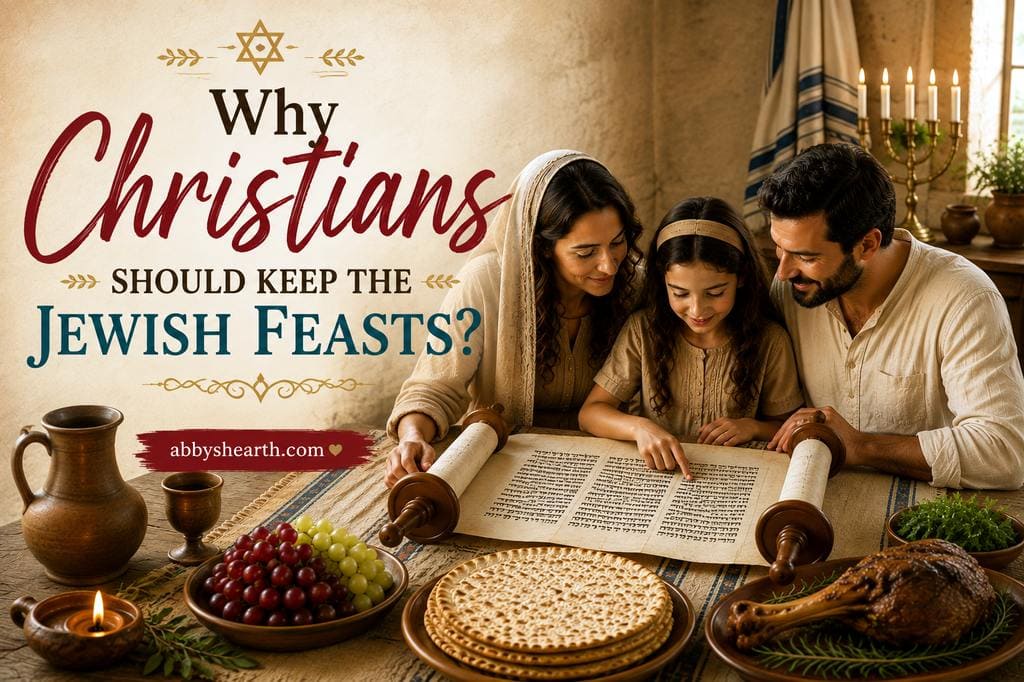
My family fasts on Yom Kippur, the Day of Atonement. And we have a running joke in the family about my birthday which is on the next day. I keep telling my parents that because they made atonement for their sins on Yom Kippur, the 10th of Tishrei, Abba gifted me to them the next day.
We’re not Jewish. We’ve had longtime Jewish family friends since before we were born, but we did not grow up observing these feasts. Yet, somewhere along the way, as our family started reading the Bible more seriously and paying attention to the Jewish roots of everything we believed, we realised we had been walking past a whole calendar of meaning that Abba had laid out long before we arrived on the scene.
The seven feasts of the Lord are not Jewish traditions that Christians don’t need to bother with. They are God’s appointed times, or moedim, in Hebrew, which literally means “appointed meetings.” Abba set them up as a recurring invitation: come and meet with Me here, at this time, and I will show you something. And when you look at what each feast points to, you find that they are not just history. They are prophecy. They map, with extraordinary precision, onto the life, death, resurrection, and return of our Lord Jesus.
The Seven Feasts — An Overview
The feasts are found in Leviticus 23, where God lays them out in order. They fall into two groups separated by several months: the Spring Feasts and the Autumn Feasts. Four have already been fulfilled in Jesus, precisely on their appointed days. Three are still ahead of us.
The Spring Feasts
1. Passover — Pesach
When: 14th of Nisan (March/April)
Passover is where it all begins. In Exodus 12, God instructs the Israelites to slaughter a lamb without blemish, mark their doorposts with its blood, and eat the meal in haste, ready to leave Egypt. The angel of death would pass over every house with the blood on the door.
Every detail of that night points forward. The lamb without blemish. The blood on the doorpost, vertical and horizontal, like a cross. The hyssop branch used to apply the blood. The instruction to eat it all, breaking no bones.
When John the Baptist saw Jesus coming toward him at the Jordan river, he said: “Look, the Lamb of God, who takes away the sin of the world.” (John 1:29)
Jesus was crucified on Passover. Not near Passover, nor around that time of year. But on Passover, the 14th of Nisan, at the precise hour the Passover lambs were being slaughtered in the Temple. Paul writes in 1 Corinthians 5:7: “Christ, our Passover lamb, has been sacrificed.”
This is not coincidence. This is a God who laid out the calendar thousands of years in advance and then kept His own appointment, to the day and to the hour.
For Christians who celebrate Passover (and more of us are beginning to), the Seder meal is one of the richest experiences of worship I know. Every element on the Seder plate, every cup of wine, every piece of matzah points to something Jesus said or did or fulfilled. The Last Supper was a Passover Seder. When Jesus broke the matzah and said “this is my body,” He was doing something His disciples understood immediately in the context of that meal.
2. The Feast of Unleavened Bread — Chag HaMatzot
When: 15th–21st of Nisan, the seven days immediately following Passover
Leaven in Scripture consistently represents sin. During this feast, all leaven is removed from the house. It’s a thorough and deliberate cleansing. The Israelites ate only unleavened bread, matzah, for seven days.
Jesus, who had no sin, was in the tomb during this feast. His body did not see corruption (Psalm 16:10, Acts 2:27). The bread of His body was without leaven aka without sin, laid in the ground like a seed.
For us, this feast carries the invitation to examine our own houses. What leaven is still in me? What needs to be found and removed? It is a feast of cleansing, of preparation, of making space.
3. The Feast of Firstfruits — Yom HaBikkurim
When: This feast falls on the day after the Sabbath during Unleavened Bread (which falls during what we now call Easter week)
On this day, the priest would wave a sheaf of the first grain of the harvest before the Lord, an offering of the firstfruits, a pledge that the full harvest was coming.
Jesus rose from the dead on the Feast of Firstfruits. Not on a Sunday that happened to be near this feast. On this feast, exactly. Paul makes the connection explicit in 1 Corinthians 15:20: “But Christ has indeed been raised from the dead, the firstfruits of those who have fallen asleep.”
The resurrection of Jesus is not just a miracle. It is a firstfruits offering, the pledge that the full harvest is coming. Every believer who has died will follow. The feast is already inside the gospel.
4. The Feast of Weeks — Shavuot (Pentecost)
When: 50 days after Firstfruits (hence the Greek name Pentecost which means pentekoste, fiftieth)
Shavuot celebrates the giving of the Torah at Sinai. Jewish tradition holds that Moses received the law on this day, fifty days after the Exodus. It is a feast of covenant, of the word of God given to His people.
In Acts 2, the disciples were gathered in Jerusalem observing Shavuot, as devout Jews would, when the Holy Spirit fell. “Suddenly a sound like the blowing of a violent wind came from heaven and filled the whole house where they were sitting.” (Acts 2:2)
On the day that celebrated the giving of the written law, God gave the living law. The Holy Spirit was written not on stone tablets but on human hearts (Jeremiah 31:33). Three thousand people died after Moses broke the stone tablets and destroyed the golden calf at Sinai (Exodus 32:28), but when the Holy Spirit fell, three thousand people came to faith that day. Death was replaced by life, and the Law was replaced by the Spirit.
The Autumn Feasts
The four spring feasts were fulfilled at Jesus’ first coming — His death, burial, resurrection, and the giving of the Holy Spirit. The three autumn feasts are widely understood to point to His second coming. They have not yet been fulfilled, but they are on the calendar.
5. The Feast of Trumpets — Rosh Hashanah
When: 1st of Tishri (September/October)
This feast is announced by the blowing of the shofar which is a ram’s horn, with one hundred blasts. It is the Jewish New Year, a day of awakening, of calling God’s people to attention.
Paul writes in 1 Corinthians 15:52 of the resurrection of the dead happening “at the last trumpet.” In 1 Thessalonians 4:16, the return of the Lord is announced “with the trumpet call of God.” In Revelation 11:15, the seventh and final trumpet ushers in the kingdom of God.
The Feast of Trumpets is understood by many Bible scholars to foreshadow the return of our Lord Jesus, heralded by a shofar blast, calling the dead in Christ to rise and His people to gather.
6. The Day of Atonement — Yom Kippur
When: 10th of Tishri, ten days after Rosh Hashanah
This is the holiest day in the Jewish calendar. The day on which, in the Temple period, the High Priest would enter the Holy of Holies once a year and make atonement for the sins of the entire nation. It could only be this one person, and on only this one day.
The entire book of Hebrews is, in many ways, a commentary on Yom Kippur. Jesus is our High Priest. He entered not the earthly Holy of Holies but the heavenly one, not with the blood of bulls and goats but with His own blood, “once for all” (Hebrews 9:12). The Day of Atonement was always a picture, and the picture has been fulfilled, perfectly, in Him.
I fast on Yom Kippur because it feels right to mark the day that pictures what Jesus did for me. Not because I’m earning anything. Not because I’m required to. But because standing before the weight of that atonement in fasting and prayer is one of the most sobering, clarifying things I do all year. It is a day to let the cross land on you again, in full.
Prophetically, Yom Kippur is also associated with Israel’s national repentance and recognition of Jesus as Messiah. This day still has to come, as described in Zechariah 12:10: “They will look on me, the one they have pierced, and they will mourn for him as one mourns for an only child.”
7. The Feast of Tabernacles — Sukkot
When: 15th–21st of Tishri, five days after Yom Kippur
Sukkot is the most joyful feast in the Jewish calendar. For seven days, Jewish families build and live in temporary booths called sukkot under the open heaven, to remember the forty years their ancestors spent in the wilderness and God’s faithfulness in providing for them. It is a feast of harvest, of joy, of dwelling with God.
“The Word became flesh and dwelt among us”. The Greek word translated “dwelt” in John 1:14 is skenoo, which means to tabernacle with or to pitch a tent. Many scholars believe Jesus was born during Sukkot, when God literally came to tabernacle with His people.
Prophetically, Sukkot points to the millennial kingdom, the age to come when Abba will dwell fully and permanently with His people. Zechariah 14:16 describes the nations coming to Jerusalem every year to celebrate Sukkot in the kingdom age.
It is the last feast. The final appointed meeting. And the picture it paints is not of a distant, impersonal God but of one who comes down to live in a booth with His children, under the same open sky, close enough to touch.
Why This Matters for Christians
The feasts do not save us. Observing them is not a requirement for Christians — Paul makes it clear in Colossians 2:16-17 that no one should judge us regarding feast days, since these are “a shadow of the things that were to come; the reality, however, is found in Christ.”
But shadows tell you the shape of the thing casting them. And if you want to understand the shape of Jesus — His life, His death, His resurrection, and His return — the feasts are one of the clearest outlines God has given us.
When I fast on Yom Kippur, I’m not trying to be Jewish. Rather, I’m standing in the shadow of a picture that points to the most important thing that has ever happened — the atonement of Jesus Christ — and choosing to feel its weight for a day.
When I celebrate Passover, I’m not adding to the gospel. I’m going back to the moment the gospel was first sketched in blood on a doorpost in Egypt, and letting that sketch remind me what the finished painting cost.
These feasts are in our Bible. The God who designed them is our God. The story they tell is our story. It is worth paying attention to.
Do you observe any of the Jewish feasts? I’d love to know how you mark them. Leave a comment below.
Further Reading on Abby’s Hearth
- 13 Types of Fasting in the Bible Every Christian Should Know — Fasting as a spiritual discipline, including the Yom Kippur fast
- What Is Zionism? What the Bible Actually Says — The Biblical roots of God’s covenant with Israel
- What Does the Bible Say About Replacement Theology? — Why the church hasn’t replaced the Jewish people
- Who Are the Palestinians? A Biblical and Historical Case for Israel — The land and the people God chose
- Books About Israel That Christians Must Read — For going deeper into the Jewish roots of the faith

Heya, I’m Abby! I’m a Gourmand Award-winning cookbook author and East Indian from Bombay, India. This blog is all about faith, food, and culture – from East Indian recipes to home, DIY, and spending time in the Word. Find out more about me here!