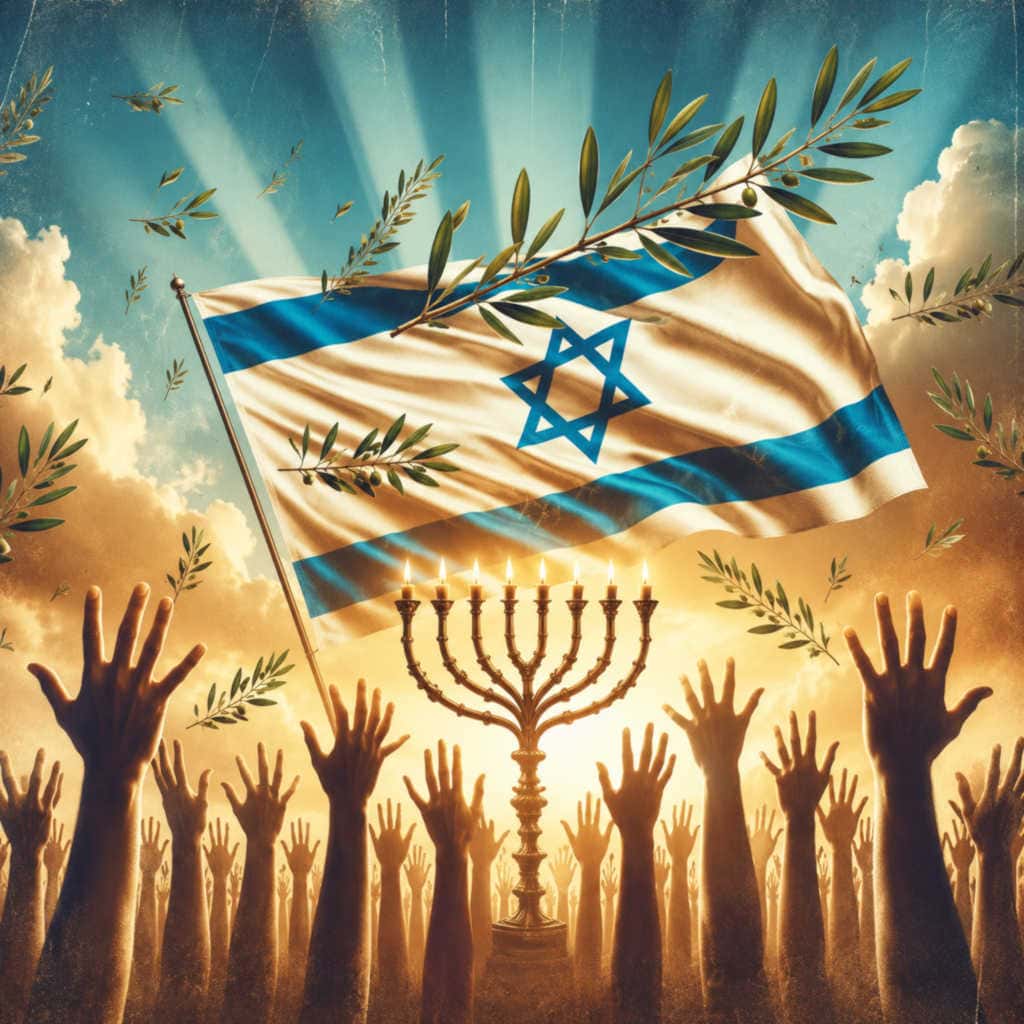
If you’ve spent any time online in the last few years, you’ve seen the word “Zionism” or “Zionist” used as a slur or an insult. It gets thrown around as shorthand for colonialism, racism, or worse. But when you take a look at what the word means, where it comes from, what Jewish people have historically understood it to mean, and what the Bible says, the picture looks very different.
This post is not about politics. It’s about a word that has been stripped of its meaning by those who weaponised it, and what happens when you give that word back to Scripture.
What Does “Zionism” Mean?
The word Zion appears more than 150 times in the Bible — in the Psalms, in the prophets, in the New Testament. It refers to Jerusalem, to the Temple Mount, and more broadly to the dwelling place of God among His people. It’s origins could be Jewish from the root צ-י-ן sayyon which means to be raised up or a sign post, or the origins could be Hitite or from the Hurrian word šeya which means “river” or “brook” because the Jebusites did live in Jerusalem before King David captured the city.
Zionism as a word simply means the belief that the Jewish people have a right to live in their ancestral homeland — the land that the Bible calls Canaan, Israel, Judea, and Zion. That’s it. That’s the core definition.
The modern political movement called Zionism was formalised in the late 19th century, largely by Theodor Herzl, in response to the rising antisemitism in Europe. Jews were being expelled, persecuted, and killed across the continent, and the movement said: the Jewish people need a homeland where they are safe, and that homeland is the land their forefathers came from.
In 1948, after the horrors of the Holocaust, the modern State of Israel was established. For Jewish people around the world, this was not a political event alone — it was the fulfilment of a 2,000-year longing to return home.
What Jewish People Understand by Zion
The phrase L’Shana Haba’ah B’Yerushalayim — “Next year in Jerusalem” — has been said by Jewish families at Passover Seder tables for centuries. It was said by Jews in exile in Babylon. It was said by Jews in medieval Europe, in the shtetls of Russia, in the ghettos of Nazi-occupied Poland. It wasn’t a political slogan, but a hope and a prayer.
The longing for Zion is woven throughout Jewish prayer, poetry, mourning, and joy. On Tisha B’Av — the fast day that commemorates the destruction of both the First and the Second Temple — Jewish communities around the world mourn. At Jewish weddings, a glass is broken to remember the destruction of Jerusalem even in moments of great happiness.
Zionism isn’t just some sort of nationalism invented in the 19th century. It’s a people who have carried the memory of a place in their hearts for millennia.
What the Bible Says About Zion and the Jewish Return
The return of the Jewish people to the land of Israel is not a footnote in Scripture. It is one of the most repeatedly stated promises in the entire Bible.
Hear the word of the Lord, O nations, and declare it in the coastlands far away; say, ‘He who scattered Israel will gather him, and will keep him as a shepherd keeps his flock.
Jeremiah 31:10 (NIV)
I will take you from the nations and gather you from all the countries and bring you into your own land.
Ezekiel 36:24 (ESV)
And he shall set up an ensign for the nations, and shall assemble the outcasts of Israel, and gather together the dispersed of Judah from the four corners of the earth.
Isaiah 11:12 (KJV)
14 “I will bring my exiled people of Israel back from distant lands, and they will rebuild their ruined cities and live in them again. They will plant vineyards and gardens; they will eat their crops and drink their wine.
15 I will firmly plant them there in their own land. They will never again be uprooted from the land I have given them,” says the LORD your God.Amos 9:14-15 (NLT)
These are not obscure passages. They are central to the prophetic books of the Old Testament. They describe quite plainly a future in which God Himself gathers His people back to the land He gave them — a land He promised to Abraham, to Isaac, and to Jacob by an everlasting covenant (Genesis 17:7-8).
If you believe the Bible is the word of God, then you have to believe that these promises are real. There’s no two ways about it. You can’t pick and choose what you want to believe from the Bible, and what you don’t.
And if you believe that these promises are real, then the return of the Jewish people to the land of Israel in 1948 after nearly 2,000 years of exile, and their continued return in large numbers is something you should celebrate. Because it means we’re getting closer to everything from the Book of Revelation and Ezekiel 38 happening, and hopefully Matthew 23:29 as well.
The Covenant That Does Not Expire
The land covenant in the Bible is explicit and unconditional. In Genesis 15, God makes a covenant with Abraham while he’s asleep — meaning Abraham contributed nothing to it. It was entirely God’s initiative, entirely God’s promise, and entirely God’s responsibility to fulfil.
18 On that day the Lord made a covenant with Abram, saying,
“To your descendants I have given this land,
From the river of Egypt as far as the great river, the river Euphrates:19 the land of the Kenite, the Kenizzite, the Kadmonite,
20 the Hittite, the Perizzite, the Rephaim,
21 the Amorite, the Canaanite, the Girgashite, and the Jebusite.”
Genesis 15:18-21 (NASB)
Abba reaffirms this very same covenant to Isaac in Genesis 26:3 and to Jacob in Genesis 28:13, and repeated throughout the Torah and the Prophets. Even in Psalm 105:8-11, King David describes it as “an everlasting covenant” because Abba promised Abraham that He will give the land of Canaan to him and his descendants as a portion for an inheritance.
The Hebrew word used here is olam — eternal, everlasting, without end.
Replacement theology — the idea that the Church has inherited all of God’s promises to Israel and that the Jewish people’s covenant with God is now void — requires you to read these verses as something other than what they plainly say. You already know why that view doesn’t hold up, but if you don’t, go read What the Bible Says About Replacement Theology?
Does Supporting Zionism Mean You Agree With Every Decision the Israeli Government Makes?
No. And this is an important distinction. Supporting the right of the Jewish people to exist in their ancestral homeland — which is what Zionism means — is not the same as endorsing every policy of any particular Israeli government. Jewish people themselves hold a wide range of political views, and robust internal debate is part of Israeli civic life. And whether you support Bibi or Yair Lapid, the important part is that you support Israel and her people, in one way or another.
What cannot be debated, from a Biblical standpoint, is whether God’s covenant with the Jewish people remains in force. It does, l’olam va’ed (forever and ever). The land promise stands! And the return of the Jewish people to that land — after extraordinary suffering and against extraordinary odds — is, to those who read Scripture seriously, one of the most remarkable signs of our times.
Why This Word “Zionism” Was Redefined
“Zionism” became a target because attacking the word is a way of de-legitimizing the existence of Israel without appearing to say so directly. In 1975, the United Nations General Assembly passed a resolution declaring Zionism to be “a form of racism” — a resolution so indefensible it was revoked sixteen years later. But the damage was already done. The word entered popular culture loaded with a meaning it was never given by the people who coined it.
When you hear someone use “Zionist” as a slur, they are using a 20th-century political redefinition, not the historical or biblical meaning. It’s worth knowing the difference.
The Mixed Jewish and Christian Perspective
This post is written from a Christian perspective, but Zionism is first and foremost a Jewish concept — rooted in Jewish longing for a return to their homeland, Jewish prayer, and Jewish history. Christians who support Israel are not doing the Jewish people a favour. They are simply reading their own Bible and believing what it says.
Many Jewish people find it meaningful when Christians take the Biblical promises seriously. They also find it puzzling when Christians who claim to believe in the God of Israel simultaneously dismiss the significance of the Jewish people’s return to their land.
But the two can’t be separated. The God of the New Testament is the God of Abraham, Isaac, and Jacob. The promises He made to the Jewish people are part of the same covenant story that Christians are grafted into (Romans 11:17-18). Understanding Zionism without the political caricature, but in it’s original Biblical and historical reality is part of understanding that story.
Further Reading on Abby’s Hearth
If this topic interests you, these posts go deeper into related questions:
- Who Are the Palestinians? A Biblical and Historical Case for Israel — the historical and Biblical case for the land
- What Does the Bible Say About Replacement Theology? — why the Church has not replaced Israel in God’s purposes
- God’s Retaliation Against Israel’s Enemies — what happens when nations rise against Israel
- What Does the Quran Say About Israel? — what Islam’s own scriptures say about the Jewish people’s connection to the land
- Books About Israel That Christians Must Read — if you want to go deeper
Do you have something to say about Zionism or Israel from a faith perspective? Leave a comment below because we’d love to hear from you.

Heya, I’m Abby! I’m a Gourmand Award-winning cookbook author and East Indian from Bombay, India. This blog is all about faith, food, and culture – from East Indian recipes to home, DIY, and spending time in the Word. Find out more about me here!