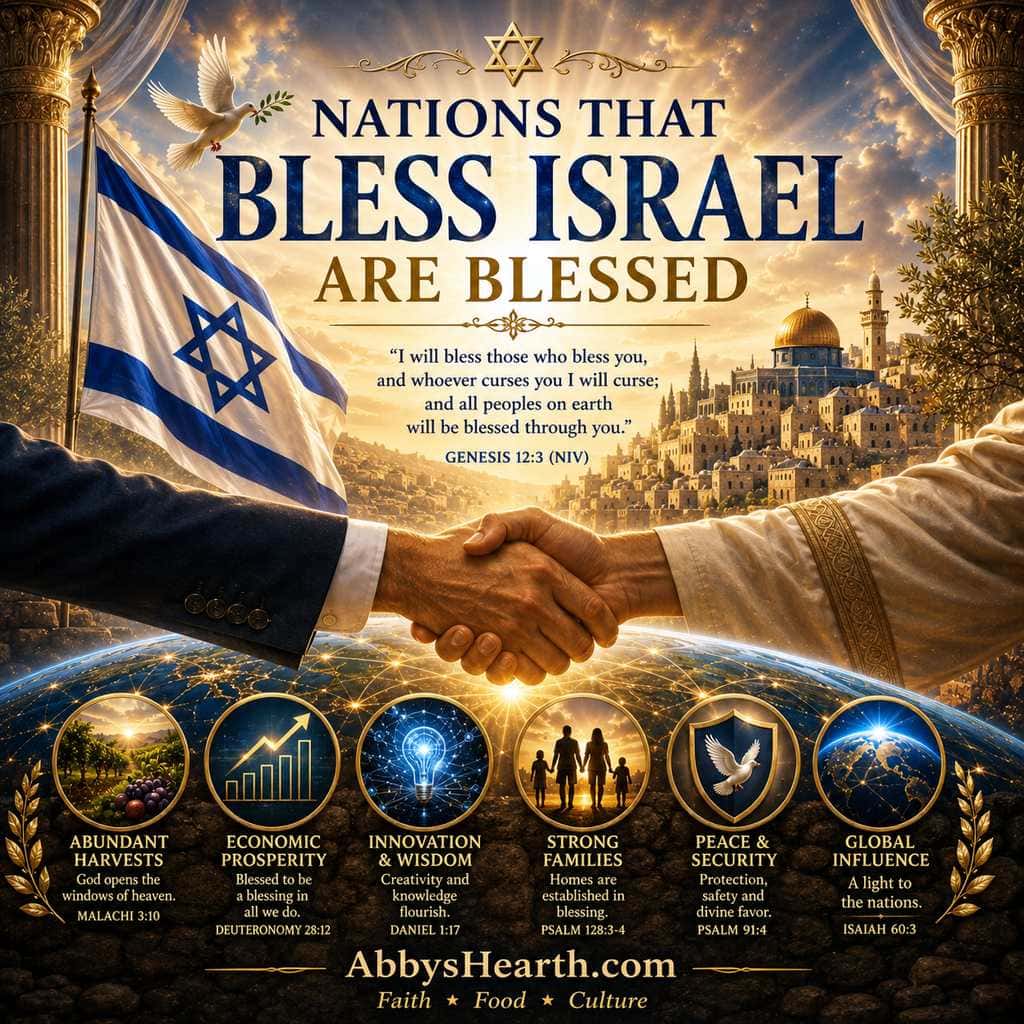
Have you ever noticed the flip side of Genesis 12:3? We spend a lot of time looking at what happens to nations that rise against Israel, and there is plenty of evidence there. But the same verse also says “I will bless those who bless you.” That promise is just as real, just as consistent, and just as traceable through history. Let’s look at the nations and the individuals that chose to stand with the Jewish people, and see what happened to these people when they did.
During the Biblical Period
| Date | Nation / Person | How They Blessed Israel | What Happened Next |
|---|---|---|---|
| Circa 1473 BC | Rahab of Jericho | Rahab sheltered the two Israelite spies sent by Joshua to scout Jericho, protecting them at great personal risk and helping them escape. (Joshua 2) | When Jericho fell, Rahab and her entire family were the only ones saved. She was brought into the community of Israel, married an Israelite named Salmon, and became the great-great-grandmother of King David — and is listed in the genealogy of Jesus Christ in Matthew 1. One act of sheltering God’s people placed her in the lineage of the Messiah. |
| Circa 1100 BC | Ruth the Moabitess | Ruth, a Moabite widow, chose to stay with her Jewish mother-in-law Naomi after both their husbands died, saying “Your people shall be my people, and your God my God.” (Ruth 1:16) She left everything to remain with Israel. | Ruth married Boaz, a wealthy Israelite, and became the great-grandmother of King David — and also appears in the genealogy of Jesus. A woman from a nation that had historically opposed Israel was grafted into the royal line of the Messiah because she chose to bless and stay with God’s people. |
| Circa 967 BC | King Hiram of Tyre | King Hiram of Tyre was a lifelong friend of David who later formed a close alliance with his son King Solomon. As a gesture of continuing friendship, King Hiram supplied cedar and cypress timber from Lebanon, as well as skilled craftsmen, gold, and other materials needed to build Solomon’s Temple, the same way he had done when King David built his palace. Without Hiram’s assistance, the Temple would have been far more difficult to complete. (1 Kings 5; 2 Chronicles 2) | Tyre enjoyed decades of profitable trade with Israel during the reigns of both David and Solomon. Hiram’s merchants partnered with Solomon’s fleet, bringing back gold, precious wood, and luxury goods from distant lands. The alliance ushered in one of the wealthiest periods in Tyre’s history. |
| 586 BC | Ebed-melech the Cushite (Ethiopian) | When the prophet Jeremiah was thrown into a muddy cistern and left to die, Ebed-melech courageously appealed to King Zedekiah and personally led the rescue that saved Jeremiah’s life. At a time when almost everyone had abandoned God’s prophet for thinking he was speaking words that weren’t from God, Ebed-melech chose to stand with him. (Jeremiah 38:7–13) | Before Jerusalem fell to Babylon, God sent Jeremiah with a personal promise for Ebed-melech. Because he had trusted in the Lord, God declared that he would not die by the sword but would escape with his life. While many perished during Jerusalem’s destruction, Ebed-melech was personally preserved by God. (Jeremiah 39:15–18) |
| 539 BC | Cyrus the Great, King of Persia | After conquering Babylon, Cyrus issued a decree allowing the Jewish people to return to their homeland and rebuild the Temple in Jerusalem, and he even funded it. In Ezra 1:2, he acknowledged God by name in his decree, saying “The Lord God of heaven has given me all the kingdoms of the earth, and he has charged me to build him a house in Jerusalem.” Isaiah had named Cyrus by name as God’s instrument 150 years before his birth. (Isaiah 44:28, 45:1) | Cyrus went on to build the largest empire the ancient world had seen, stretching from the Aegean Sea to the Indus Valley. He is remembered as one of the greatest rulers in human history, and the Cyrus Cylinder (now in the British Museum) is considered one of the earliest declarations of human rights. God called him His “anointed”, an extraordinary title for a pagan king. |
| Circa 520–515 BC | Darius I of Persia or Darius the Great | When enemies tried to stop the rebuilding of the Second Temple in Jerusalem, King Darius searched the royal archives and confirmed Cyrus the Great’s original decree. He ordered that the Jews be allowed to continue rebuilding the Temple without interference and even commanded that the costs be paid from his royal treasury. Darius the Great also supplied animals, wheat, wine, oil, and salt for the Temple sacrifices, ensuring that worship in Jerusalem could continue unhindered. (Ezra 6:1–12) | During Darius’ reign, the Second Temple was completed in Jerusalem. And the Persian Empire reached one of the greatest periods of prosperity and stability in its history. Darius the Great is remembered as one of Persia’s greatest kings. While Scripture doesn’t explicitly say his success came because he blessed Israel, the timing closely aligns with Abba’s promise to bless those who bless Abraham’s descendants. |
| Circa 445 to 443 BC | Artaxerxes I | Artaxerxes I was a son of Xerxes I (Xerxes the Great), the Persian king traditionally identified as Ahasuerus in the Book of Esther. He was the Persian king traditionally identified as Ahasuerus, who allowed the Jews to defend themselves during the events commemorated at Purim. In the 7th year of his reign, Artaxerses allowed Ezra and a company of Levites to go back to Jerusalem and take charge of the religious and civil affairs. In the 20th year of his reign, he granted his cup-bearer Nehemiah’s requests to go back and complete the rebuilding of Jerusalem. In Nehemiah 2:6, it’s mentioned that the Queen was sitting beside Artaxerxes (King Ahasuerus) when this permission was given. Some scholars believe that his mother was Queen Esther. The King also funded the rebuilding of Jerusalem and Nehemiah rebuilt the wall in 52 days. | Artaxerxes I enjoyed a long (mostly peaceful) reign of about forty years, during which the Jewish community in Jerusalem experienced significant religious and civic restoration. |
Jael the Kenite could also have been included in this list. By protecting God’s people, she received one of the highest commendations in Scripture from Deborah. However, because neither the Bible nor history records what became of her afterward, we cannot point to any later blessings with certainty.
In the Last 500 Years
| Date | Nation / Person | How They Blessed Israel | What Happened Next |
|---|---|---|---|
| 1600s | The Dutch Republic — the Netherlands | When Jews were being expelled across Europe, the Netherlands opened its doors. Sephardic Jews fleeing the Spanish Inquisition and Ashkenazi Jews fleeing violence in Eastern Europe were welcomed into Amsterdam, allowed to practice their faith freely, and permitted to participate in commerce. Jewish merchants, bankers, and entrepreneurs became an important part of Dutch commercial life and contributed to the expanding trade networks that helped fuel the Dutch East and West India Companies. | The 17th century became the Dutch Golden Age; a period historians have called the “Dutch Miracle.” A small nation of just two million people became the dominant maritime and economic power in the world, leading Europe in trade, science, art, and finance. Amsterdam became Western Europe’s wealthiest city. Historians generally agree that the skills, capital, and international trade connections brought by Jewish immigrants were among the factors that contributed to Dutch commercial success during the Golden Age. |
| 2 November 1917 | Great Britain — the Balfour Declaration | British Foreign Secretary Lord Balfour issued a declaration stating that Britain viewed “with favour the establishment in Palestine of a national home for the Jewish people.” It was the first time a major world power officially endorsed the Zionist cause and became one of the key diplomatic milestones leading to the eventual establishment of the State of Israel. | Britain was at the height of its global influence in 1917, and this act of blessing Israel’s dream of a homeland came at a moment of enormous historical consequence. Britain remained one of the world’s leading powers for decades after the Balfour Declaration. Many Christians view this as an example of the principle found in Genesis 12:3, while historians point to a range of political, military, and economic factors that shaped Britain’s fortunes. |
| 14 May 1948 | The United States of America — President Harry S. Truman | At midnight on May 14, 1948, Israel declared independence. Eleven minutes later, the United States became the first nation in the world to extend de facto recognition to the new State of Israel, while the Soviet Union gave de jure recognition shortly afterward. President Truman made this decision against fierce opposition from his own Secretary of State and senior advisers, who warned it would antagonise Arab nations and jeopardise American oil access. Truman, a Bible-reading man from Missouri, acted on his convictions. He reportedly said: “I had faith in Israel before it was established.” | The decades following World War II saw the United States emerge as the world’s leading economic and military superpower. Those who see a connection with Genesis 12:3 often point to the remarkable prosperity and influence America enjoyed in the decades following its early recognition of Israel. |
A Note Worth Making
The pattern is consistent but it cuts both ways. Britain issued the Balfour Declaration in 1917 and was blessed. But Britain also later frustrated Jewish immigration to Palestine during the Holocaust years, and issued the 1939 White Paper severely limiting Jewish entry into their own promised homeland, just as the Jews of Europe most desperately needed somewhere to go. The British Empire’s decline accelerated sharply after the Second World War. The nation that blessed Israel was blessed. The same nation, when it turned and restricted Israel, began to lose what it had.
God is not mocked. The covenant in Genesis 12:3 runs in both directions.
Nowadays, some Christians also point to the Abraham Accords as a contemporary example of nations seeking peace and cooperation with Israel. Signed in 2020, these agreements normalized relations between Israel and several Arab nations, opening the door to increased trade, tourism, investment, and diplomatic cooperation.
Because the accords are still relatively recent, history has yet to reveal their full significance. Whether they will ultimately become another example of the principle found in Genesis 12:3 remains something future generations will be better able to judge.
History is not random. Empires rise and fall, nations prosper and collapse, and if you look closely enough, the thread of Genesis 12:3 runs through all of it.
Time and again, the nations that opened their doors to the Jewish people, that recognized Israel’s right to exist, or chose peace over hostility experienced remarkable seasons of influence and prosperity. They were blessed. Not always immediately, not always in the way they expected, but blessed nonetheless.
And the ones that turned? We covered those in the companion post. The God of Abraham, Isaac, and Jacob does not change. His word does not return void. If you needed any more reason to pray for the peace of Jerusalem, let history be your motivation, and let scripture encourage you. Psalm 122:6 says it plainly — “Pray for the peace of Jerusalem: they shall prosper that love thee.” Prosperity is the promise. Loving Israel is the condition. The evidence is all around us.
Other Posts about Israel you might like:
- Nations that fought against Israel and what happened to them
- What is replacement theology?
- What does the world owe Israel?
- Men of God that Abba loved
- What will happen in the end times?

Heya, I’m Abby! I’m a Gourmand Award-winning cookbook author and East Indian from Bombay, India. This blog is all about faith, food, and culture – from East Indian recipes to home, DIY, and spending time in the Word. Find out more about me here!